



Excellence=Resources+Intelligence+Solutions
EIOS (ERIS Intelligence OS) is an enterprise operating system that reorganizes the flows of information, people, and institutions into a single integrated architecture of intelligence. In principle, corporate activity consists of a continuous process of information acquisition, interpretation, decision-making, and institutionalization. In reality, however, work becomes siloed, decisions are dispersed and personal, and institutional frameworks often drift away from actual operations. EIOS addresses these gaps by unifying the organization around a single axis—the circulation of intelligence—and reconstructing its internal cognitive functions.
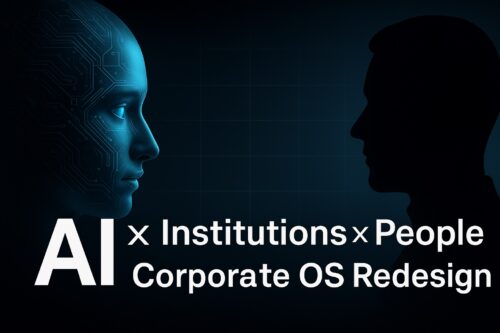
In recent years, the advancement of AI has accelerated the pace of corporate change to an unprecedented level. As people, institutional systems, and AI now operate at different rhythms, organizations require a new design that synchronizes these three elements on a common foundation. The purpose of EIOS is to connect the inherent strengths of people and institutions with the processing capabilities of AI, thereby elevating the overall performance of the organization.
At the core of EIOS lies ERIS’s intelligence model. Information holds no value simply by being collected; it becomes organizational power only after being structured, evaluated, and institutionalized. EIOS integrates four layers—EP (information resources), EOI (operational intelligence), EDI (decision intelligence), and EII (institutional intelligence)—and transforms them into a mechanism that enables the autonomous reproduction of intelligence within the enterprise. It forms the foundation for evolving into an “intelligence-circulating organization,” where information flows, decisions deepen, and institutional systems continually learn.
To implement this integration in practice, our company will launch an enterprise OS update initiative in April 2026, combining EP, EOI, EDI, and EII in a phased rollout. This project moves beyond the limits of conventional consulting and directly reconfigures the internal architecture of the organization into a future-ready design.
EIOS is not a system that imposes transformation on organizations. Rather than pursuing reform strategies that depend on pain or resistance, EIOS aims to create an enabling “vessel” in which the organization can function naturally and coherently. By clarifying and separating the roles of people, institutions, and AI, and supporting them on a unified foundation of intelligence, organizations gain both autonomy and stability. EIOS serves as a quiet internal infrastructure of intelligence—an OS that sustains an organization’s capacity to learn, even as external environments continue to shift.
EP – ERIS Platform
Information transforms from a resource into fuel, and ultimately into power. EP processes organizational knowledge and external intelligence through a three-stage AI-driven sequence:
1. Accumulation as a resource
2. Structuring as fuel (AI extraction, refinement, and organization)
3. Activation as power (directly driving decision-making and operations)
Information alone does not create outcomes. EP converts information from resource to fuel, and finally into organizational power. It serves as the central engine supplying data and decision material essential for internal AI, EOI, and EDI.
EOI – ERIS Operational Intelligence
EOI connects organizational operations with AI and builds the mechanisms that allow the organization to “move.” It redesigns the operational architecture by aligning human roles, institutional rules, and AI capabilities. Its objectives are threefold:
1. Identify where AI can create impact through a comprehensive audit of tasks
2. Define the division of labor among people, institutions, and AI, eliminating waste
3. Reallocate freed resources toward areas directly linked to results
EOI integrates AI agents, redesigns processes, implements monitoring, and—when appropriate—connects with the Three-Tier™/3階建®制度 HR system. We begin with prototype implementation in functions such as recruitment, HR, general administration, and corporate planning, then expand progressively into production management, sales, and service operations.
EDI – ERIS Decision Intelligence
EDI is the foundation where executives, AI, and human consultants engage in dialogue to shape decisions. It is not only an analytical engine for management decisions but a three-party collaborative system in which executives interact with AI, supported by human consultants.
AI analyzes diverse information—policy, legal frameworks, competition, and organizational data—structure problems, generate options, predict risks, and propose recommended actions. Executives build their decision axes through dialogue with AI, while our consultants intervene throughout the process, integrating human and AI perspectives to enhance decision quality.
EDI does not replace human judgment. Instead, it extends the range of executive thinking and improves the precision and speed of decision-making through data, inference, and structured dialogue.
EII – ERIS Institutional Intelligence
EII builds institutional architectures optimized for the AI era while fully respecting each company’s existing HR systems. Although the Three-Tier™/3階建®制度 system is a powerful option, its adoption is not assumed. Instead, EII evaluates each organization’s history, culture, industry attributes, and internal dynamics to determine which parts of the current system should be retained, updated, or integrated with AI.
EII covers compensation structures, evaluation systems, job/grade frameworks, compliance, and governance rules. It identifies improvement points using external conditions and internal data, guiding the organization toward continuously updatable institutional systems. EII treats institutional design not as a static document but as a living architecture, optimized in conjunction with outputs from EOI and EDI.
The goal is not to replace existing systems but to ensure that institutional design accelerates, rather than constrains, organizational movement. Whether to adopt Three-Tier™/3階建®制度 or reinforce current frameworks is determined flexibly based on each company’s circumstances.
Transition to a Self-Driving Organization through the Integration of Four Domains ―― EP transforms information from resource into power. EOI links operational architecture with AI. EDI supports decision-making. EII strengthens institutional coherence. When the four domains work together, the organization becomes self-driving—capable of moving, learning, and correcting itself without depending on external conditions.
This is not a scenario where AI replaces human beings. Rather, people, institutions, and AI complement one another, enabling the entire organization to reach a higher level of performance. This integrated project is the centerpiece of ERIS Asia’s new initiative to be rolled out progressively from 2026.
Contact:ERIS Asia