




Excellence = Resources × Intelligence × Solutions
ERIS® is an integrated framework designed to reorganize the flows of information, people, and institutions that constitute an enterprise into a single coherent intellectual architecture. Corporate activity, in its true form, is not linear but cyclical: information is acquired and evaluated, judgments are made, decisions are institutionalized, operated, and re-evaluated, and the results of those decisions are accumulated and updated as the premises for the next round of judgment. In reality, however, information is fragmented, decision-making becomes overly dependent on individuals, and institutions are fixed as remnants of past decisions, increasingly detached from current operations and changing environments.
ERIS® addresses this fragmentation not as a matter of isolated operational improvements or partial institutional reforms, but by reconnecting these elements through a single axis: the circulation of intelligence. Rather than treating institutions as static end products, ERIS® redefines them as structures that store the outcomes of judgment within the organization, enabling subsequent decisions to become more precise. Through this approach, ERIS® reconstructs the internal intellectual functions of the organization.
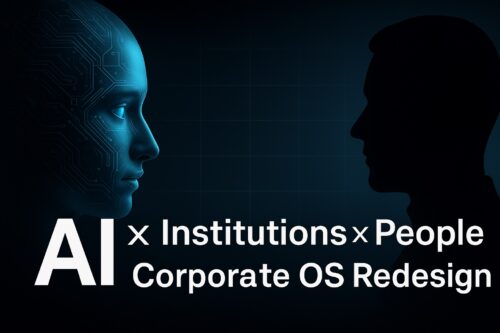
In recent years, advances in artificial intelligence have placed corporate management in an environment where speed, complexity, and uncertainty simultaneously intensify. Humans, institutions, and AI each operate according to different roles and time horizons. Without a design that connects and coordinates these elements on a common foundation, decision-making becomes fragmented and accountability obscured. The purpose of ERIS® is to integrate the judgment capabilities and responsibility structures inherent to people and institutions with the processing power of AI, thereby continuously enhancing the organization’s overall decision-making performance.
ERIS® is not a single tool. It is an integrated architecture composed of multiple functional domains—information, operations, institutions, and decision-making. Companies can begin implementation from whichever domain directly addresses their most pressing challenges. There is no requirement to start with information organization or operational improvement; it is equally possible to begin with institutional reform or the redesign of governance structures. Regardless of the entry point, however, ERIS® is designed to maintain an overall structure in which decision premises are continuously updated through an intelligent cycle.
EI – ERIS® Intelligence
Corporate decision-making is shaped less by strategy or systems themselves than by the quality of the information on which they are based. When information is fragmented or dependent on individual experience, decisions inevitably become unstable. ERIS® Intelligence (EI) is designed as an intelligence infrastructure that continuously gathers, structures, and delivers the information necessary for corporate decision-making in a form usable for management judgment.
EI is not merely a news distribution service. It combines AI-based information collection with human institutional and management analysis to organize developments in policy, regulatory changes, industry structure, and technological progress from the perspective of corporate management. The objective is not to increase the volume of information, but to extract information that carries real meaning for decision-making.
Within the ERIS® framework, EI functions as the information foundation supporting corporate decision-making. For institutional design and organizational management to remain aligned with reality, companies must continuously observe changes in the external environment and maintain well-structured decision premises. EI is designed as the intellectual infrastructure that enables this process.
【Operational Examples】
● EHR – ERIS® HR Report
ERIS® HR Report (EHR) is an intelligence product within the EI framework specializing in human resources and labor management. It continuously organizes developments in labor law reforms, court decisions, policy trends, changes in HR systems, and practical organizational management issues across multiple jurisdictions. Rather than simply presenting news, EHR reinterprets information through the lens of institutional and managerial impact, providing structured insights that support corporate HR decision-making.
● ERIS® China Textile & Apparel
ERIS® China Textile & Apparel is an industry intelligence product that continuously analyzes corporate developments, market structures, pricing strategies, and brand strategies within China’s textile and apparel industry. Because the Chinese market evolves rapidly, individual news items alone cannot provide a clear picture of the overall landscape. This service systematically tracks and analyzes the strategies of major companies and broader market trends, providing companies with an information foundation to understand structural changes in the Chinese market and support their business decision-making.
EPE – ERIS® Profit Engine
ERIS® Profit Engine (EPE) is a management engine that connects a company’s internal operational structure with AI, redesigning both its profit architecture and resource allocation. It is not merely a tool for improving operational efficiency. EPE makes visible where value is created, where it accumulates, and where it is lost—and restructures the underlying architecture itself.
Its scope is not limited to the back office. From HR, administration, and corporate planning functions to production lines, warehouses and logistics hubs, as well as service operations such as hotels and restaurants, EPE encompasses every domain where profit is generated. The objective is not to introduce AI for its own sake, but to identify where connecting AI will fundamentally transform the profit structure.
EPE’s core functions can be distilled into three elements.
First, to identify the true sources of value creation through a comprehensive operational inventory.
Second, to design the division of roles among humans, systems, and AI, thereby clarifying the boundaries of responsibility and performance.
Third, to reallocate freed-up resources into areas directly linked to results.
When necessary, EPE integrates with the 3階建®制度/Three-Tier™ framework—maintaining stability at T1, redefining roles at T2, and distributing results at T3. EPE is not a cost-cutting device; it is a Profit OS that reconstructs the organization as a whole.
[Operational Cases]
● Back Office
In recruitment, HR, labor management, and corporate planning, duplicated approval processes and redundant information handling quietly erode profits. EPE extracts inefficiencies through a structured operational inventory and connects them to AI-driven automation and decision support. The time reallocated to strategic functions is then reflected in T3. This is not mere task reduction, but a conversion toward value creation.
● Production Sites
In factories, utilization rates, yield, downtime, and improvement activities directly determine profitability. Robots and IoT generate data, yet roles and responsibilities often remain anchored in legacy structures. EPE visualizes value added by process, defines role transitions from operator to supervisor at T2, and links improvement contributions to T3. It fills the institutional vacuum that frequently follows automation.
● Warehousing and Logistics
Inventory turnover, misdelivery rates, and lead-time reduction have immediate profit impact. EPE connects logistics KPIs to the profit structure and embeds operational improvements into the distribution logic. AI-driven demand forecasting and route optimization are tools; sustainable profitability ultimately depends on the design of allocation and accountability.
● Hotels and Food Service
Room occupancy, table turnover, average spend per customer, and cost ratios fluctuate daily. AI may be used for pricing optimization and demand forecasting, yet improvements in service quality and operations often fail to translate into compensation. EPE links occupancy gains, waste reduction, and customer satisfaction metrics to T3, while redesigning roles at T2. Service industries, with their high data immediacy, are particularly conducive to effective Profit Engine implementation.
EPE is industry-agnostic. It integrates manufacturing, logistics, service operations, and administrative functions within a unified profit architecture. It does not treat AI adoption as an end in itself; rather, it redesigns the sources of profit generation and the structure of distribution. That is the essence of EPE.
EGS – ERIS® Governance Structure
ERIS® Governance Structure (EGS) is the domain dedicated to reconstructing governance and institutional architectures that are optimized for the AI era while respecting existing systems. The 3階建®制度/Three-Tier™ system is one viable option, but its adoption is not a prerequisite.
Taking into account each company’s history, culture, industry characteristics, and organizational dynamics, EGS determines which institutions should be preserved, which should be updated, and which elements should be connected to AI. Target areas include compensation structures, evaluation systems, grading frameworks, job architectures, compliance mechanisms, and governance rules. Institutions are positioned not as static documents, but as architectures that are continuously adjusted in response to changing conditions.
EDN – ERIS® Decision Navigator
ERIS® Decision Navigator (EDN) is a decision-support foundation where executives, AI, and human consultants collaborate in the decision-making process. AI analyzes diverse information sources across domains and presents issue structures, options, risks, and projected outcomes.
In this process, AI conducts cross-sectional analyses of policies, laws, competitors, and organizational data, generating structured issues, alternative options, risk forecasts, and recommended actions. Executives refine their decision axes through dialogue with AI, while our consultants intervene throughout the process to integrate AI-based insights with human perspectives and enhance the overall quality of decision-making.
EDN does not replace executive judgment. It functions as a navigator that expands the scope of thinking and improves both the accuracy and speed of decisions by supporting them with data, reasoning, and structured dialogue.
ERIS® is not a reform model that prescribes fixed entry points or implementation sequences. Regardless of where an organization begins, ERIS® maintains a structure in which information, operations, institutions, and decision-making remain mutually aligned, enabling the organization to function autonomously and sustainably. By clearly separating the roles of humans, institutions, and AI—while supporting them on a unified intellectual foundation—ERIS® provides an infrastructure of intelligence that enables organizations to withstand external change and continue learning over time.
Contact:ERIS Asia